Showing posts with label 2011. Show all posts

Saturday, 22 June 2019

Learning from Others

Yes, sigh, I know; nothing for ages and then two posts in one day.  I've spent the day consolidating my list of outstanding posts going back now ONLY to 2015.  I will get there, eventually.  Whilst so diligently engaged, I found this post from a visit to the Portimao Museum, Portugal in 2011 and thought it worthwhile revisiting in light of my OTS (quilts-by-me blog) and other artistic endeavours.   

Portimao: Photo Marathon.  The Portimao Museum had organised a Photo Marathon Competition (2011) and on our visit we were fortunate to see the creative results.  Firstly there were 2 categories – Underwater (serious underwater camera work) and Digital.  Each category was then broken down into a series of themes to which the entrants had to produce 3 A4 sized photos.  Digital for example, had 8 themes and therefore needed to produce 24 photos.  These photos were simply mounted on card (no frames) and exhibited in theme order.

Seeing them made me understand why the winner had been chosen.  His work was essentially the tightest – all photos were portrait, all perfect close-ups that complemented each other, of subjects that spoke clearly of each theme yet related well as a whole.  The colours were bold and dramatic subject lighting was well balanced throughout.  In this way the whole worked as a complete presentation, flowing well as a design, almost mosaic like in quality, which fitted the surrounding old city (and its pavings).
Being a quilter I got a little caught up in this project.  A big part of working in textiles is taking the time to stand back, balancing the “pieces” or blocks into a well-balanced whole.  So, I learned quite a lot about the value of working in series; imagining connections between a single work, a series or indeed of a larger body of work – just like an artistic mind map.  Fascinating.

I sadly don’t have any photos of these photographic works at the Museum (no photos allowed) so I’ve included some general ones from their collection instead to add to the watery theme.

(By the way, I hope the new Tag boxes make searching easier...)

Saturday, 18 February 2012

Quilt (or Guilt) Tripping No#4

Southern Highlands (3 December 2011)

Another day out that pleases us quilting ladies is one spent combing the delightful Southern Highlands for fabrics to start new or finish older projects.  We start early, usually having a coffee in the park opposite the Village Quilt Shop in Station Street Mittagong.  The park used to have a wonderful display of tulips in the garden (at the right time of the year).  We’ve always promised ourselves an opportunity to do a class in the Village Quilt Shop as it always seems to have something that inspires us. 

From there we detour via Bowral, trying not to stop at the cafes, and out over the railway line to Berrima.  A nice round-about trip through lush country and nearby area famous for filming of “Babe” brings us to Berrima Patchwork.  This shop is also a great Highway stop on the way to or from Sydney.  Many is the time I’ve come to a screeching halt there at 4.45pm on my way back from Canberra….  This is another shop that has a wide range of goods and last time I visited there was a wonderful collection of linens to make that French provincial pattern on my list of must do’s.  Berrima Patchwork also makes up nicely matched bundles of fabrics that really help when you want to work to a specific colour theme and don’t have the time to do the leg work &   start from scratch. 

On the way back from Berrima along the Old Pacific Highway, take time to turn into the small industrial area near Cavendish Street.  There you will find two delights.  Japanache has a nice selection of Japanese fabrics, traditional sashiko threads and other goodies to add to your stash.  If you’re starting to suffer fabric burnout, then try to walk past their collection of kimonos, furniture items or ceramic dishes.  Sigh!

A little further on in Davey Street is My Place with its collection of Amy Butler prints and patterns.  Nice, fresh and young – this is the home for quilters of the modern style.  They have some easy patterns for sewing children’s clothes too.  From here, it’s an easy trek back into Bowral for some lunch.  Too many cafes and not enough time to choose!  Find the one with the nicest cakes….

Back out to the Highway and on to Timeless Threads in Mittagong.  Now I can never walk out of this shop without buying something.  This time it was a rather nice “heritage” style scrap quilt pattern to do some therapeutic hand piecing and use up that growing box of scraps.  Both features of my new year’s resolution list – not to waste time or fabric!

Lastly, if we haven’t dallied too much, is a quick side-trip into Victoria House.  This long-time favourite is home to a dazzling array for needlecrafters – cross stitch, tapestry, you name it they have it.  From there it’s an easy drive out to the highway to get home.  Did I really buy that much (again)?


Christmas Lunch 2012 in Bowral (with a treat desert tray)

Thursday, 16 February 2012

Designing Matters in Portugal

Terciera Museum
Azores: Azulejos.  Blue and white tiles – what more can I say?  Introduced by the Moors in the 15th c this popular form of decorating both internal and external walls is still popular today.  Rather than explain the history of azulejos, you best check out wiki.   These are just a few of the ones we saw during our stay in the Azores.  I would have happily replaced tonnes of lead ballast with tile, but sadly the captain reneged on this plan. 

Cascais: Paving.  We were taken by traditional pavings of basalt and limestone pieces meticulously set by craftsmen in amazing designs.  Of course, these artistic pavements are not limited to the narrow streets of old town Cascais. We first made their acquaintance in the Azores.  Ships and sea motifs are quite common in this art that has been practised long before Greek and Roman times.
This is Horta in the Azores.  Cascais had similar pavings
Lisbon: Manueline Architecture (1490-1520).  Who could not be attracted to the excesses of Manueline style?  Elaborate, rich, excessive are terms that slip easily off the tongue when describing this mix of Renaissance & Gothic motifs.  Lisbon of course, is the centre of excellence when it comes to definitive examples of this fine style.

Sines: Roman Ruins.  Although more famous as the birthplace of Vasco da Gama, one of the first to make incredible and slow voyage to India, Sines has hidden treasures inside the medieval district that predate this event.  We’re talking fragments of nearby Roman settlements.  These pieces, 2000 years old, can be found in their compact Archaeological Museum of course.  Romans were the wanderlusts of their time and they build fine cities with many functional and beautiful features.  Nearby, an excavated Mirobriga stands as a testament to these skills.  Interestingly, Sines claims even earlier Iron Age settlements.  As we sat on the beach near our anchorage, sipping our evening “sundowners” and contemplating the meaning of life, we wondered how many others before us had walked on the sand and sailed its seas.  A quiet moment for some almost mind-bending reflection…. 
Old Portimao
Portimao: Photo Marathon.  

The Portimao Museum had organised a Photo Marathon Competition (2011) and on our visit we were fortunate to see the creative results.  Firstly there were 2 categories – Underwater (serious underwater camera work) and Digital.  Each category was then broken down into a series of themes to which the entrants had to produce 3 A4 sized photos.  Digital for example, had 8 themes and therefore needed to produce 24 photos.  These photos were simply mounted on card (no frames) and exhibited in theme order. 

Ceramics on exhibition at
the Portimao Museum 2011
Seeing them made me understand why the winner had been chosen.  His work was essentially the tightest – all photos were portrait, all perfect close-ups that complemented each other, of subjects that spoke clearly of each theme yet related well as a whole.  The colours were bold and dramatic subject lighting was well balanced throughout.  In this way the whole worked as a complete presentation, flowing well as a design, almost mosaic like in quality, which fitted the surrounding old city (and its pavings).

Being a quilter I got a little caught up in this project.  A big part of working in textiles is taking the time to stand back, balancing the “pieces” or blocks into a well-balanced whole.  

So, I learned quite a lot about the value of working in series; imagining connections between a single work, a series or indeed of a larger body of work – just like an artistic mind map.  Fascinating. I sadly don’t have any photos of these photographic works at the Museum so I’ve included some general ones around Portimao instead.
Could that be a fishing boat?  Arade River, Portimao

Tuesday, 14 February 2012

In Any Language

Still in the Azores....

A few traditional textile terms that I came across in the Azores which needed further exploration were:
Green Fields above the Harbour in Horta, Fiail
Manta de Retalhos.  This term is often used when describing a landscape of green fields, likening the scene to a “patchwork quilt”.  The term translates loosely as “motley” although I suspect we would think in terms of scrap or charm quilts.  Inner Blooming has a photo of her interpretation on the subject of traditional mantas or quilts, which is more to the point.  Featured are reds, blacks and whites – traditional colours. This was the closest reference I could find.
Woad, a souce of blue dye.
Colchas de Ponto Alto.  Weaving typical of Sao Jorge.  Handloomed quilts described as “high points” or webs of St George. 
Tolha de mesa (Terciera) Tablecloth
Manta de Farrapos are made on wooden looms with left over strips of colourful fabrics.  Fabrics are torn or cut into strips, joined end to end and then rolled into balls of “yarn”.  These strips are handloomed into colourful rag rugs.

Colcha (Terciera) Quilt
Cobertores are blankets and I’m presuming woollen ones at that. Pano de terra woven on Terciera were also made of wool.

Dyes grown on the islands included woad (blue), cudbear (purple) and dragon tree fruit (red). 
Pano de cozinha (Terciera) Kitchen Cloth
Cloth was typically woven from flax, linen, tow (a course linen), rags or wool on horizontal looms. 

Don’t for one minute think this was easy to put together.  What a tangled mess with too few examples (on line) and too little information, so do feel free to expand this list of traditional Portuguese weaving and quiltmaking terminology.  I am also wondering too if there isn’t some mix in the translation between blankets & quilts and woven (loomed) and stitched.  Unfortunately it’s too late now.  What is not lost however is the meaning attributed to these traditional handcrafts.  Weaving has been practised for centuries and the practice of re-use, now fashionable in our throw-away society, essential.  Patterns were traditional and most likely varied from village to village.  If you want to see some brilliant modern day interpretations though, try these by Joao Burno Videira.

Sunday, 12 February 2012

Finding Dragon's Blood

The Azores are a stunning group of islands in the middle of the Atlantic Ocean - more or less.  We found ourselves adrift for at least 5 weeks exploring them.  This is my textile take:

Flores.  By far the most remote island and said to be the most easterly point of Europe, this fragile island is what I image Portugal was like some hundred years ago.  Dotted with little villages, bright green fields hedged by blue hydrangeas and surrounded by wild seas and huge basalt cliffs – we loved it. 

The cottages in particular - little white buildings in traditional style with vivid blue trim and every window hung with lace.  This island is renowned for its lace, crochet and embroidery, although we were unable to find much evidence of it – perhaps too precious a commodity to make for tourists.  Interestingly, we were told Flores was settled to grow woad (indigo) commercially.

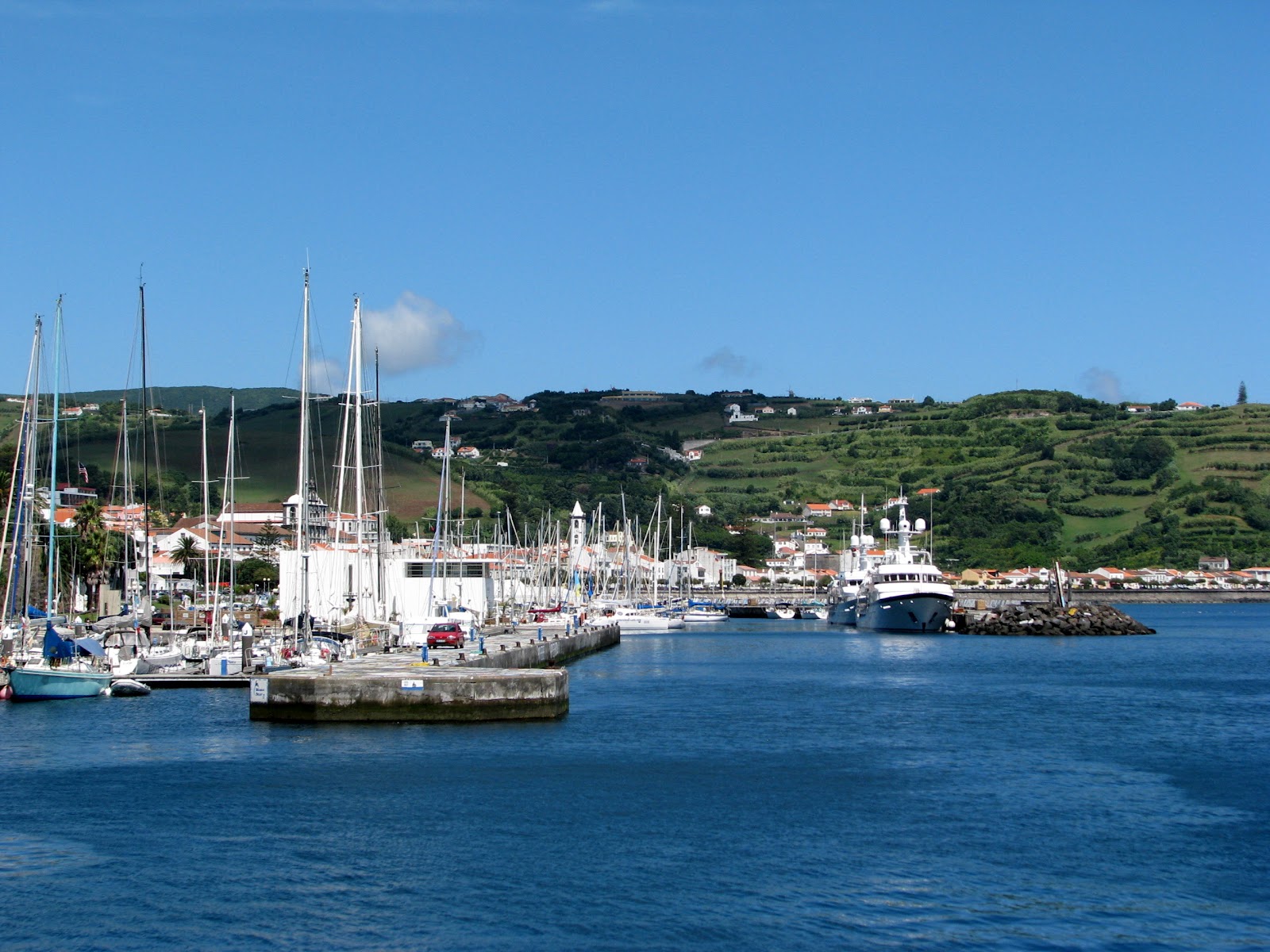
Faial.  Friendly Faial is home to Horta, destination and safe harbour for trans-Atlantic sailors.  This small harbour town has been host to many Grand Voyages over the centuries, although that nasty Sir Walter Raleigh did burn it to the ground in 1597. 

Horta’s museum, housed in a building of historical consequence, has in its collection a traditional long black cloak and hood worn by women in 18th c.  Now seldom worn, we were fortunate to see this capote and capelo being worn at a Marina-side shindig – a bit of an island produce & cultural affair.  (The attached photo is a bit fuzzy but you'll get the gist.)

Faial is also known for its traditional straw on tulle embroidery although we didn’t see any examples on our round island bus jaunt.  We did discover later that had we stopped at Capelo Village we could have seen local handicrafts being made. 


Pico.  Pico is the summit of the greatest mountain range in the world; one of a number of volcanos, many submarine, along the Mid-Atlantic Ridge.  We headed for the wine museum sheltered under this fuming, cloud encrusted brow to learn about traditional methods employed in island wine growing and making. (Oh well, someone has to do it in the name of research!)  Its wines have graced many an aristocratic table over the years.

Here, at the Museum, I also learned about local production of a red dye made from the fruits and seeds of the dragon tree - seen at left.  Red dye was used to colour threads for weaving cloth. Pico is also known for scrimshaw, lacework and cheeses. 

Essential velvet & red combo
necessary to attract bulls
Sao Jorge.  We had planned to stop here but at the mercy of the winds, it was not to be.  Saint George, like Corvo, has a history of handloom weaving.  Corvo folk typically used dark blue (indigo) and white threads in traditional complex methods of stripe seen in their woollen hats – a bit like fair isle patterning.  Sao Jorge added red to the mix (dragon’s blood) and produced colchas de ponto alto or high point quilts woven on handlooms. 

Terceira.  Although famous for its loom woven quilts made from geometric shapes (squares, diamonds and strips) from multi-coloured wools and hand sewn embroidery on white or red linen, we saw few examples on our travels round this lush island. Red & yellow woven jacquard weaving is also said to be popular. 

Sao Miguel has a history more focused on tea and pineapples.  One can imagine these extraordinary treats grown on Sao Miguel gracing tables of kings and noblemen.  Ponta Delgada was our last stop before heading on to mainland Portugal and it is certainly the most modern city of the islands.  We gave textile seeking and museums a miss and went instead to the village of Furnas for a soak in hot bubbling springs and a walk through age old botanic gardens.

Picture Postcard Gardens in Sao Miguel (Furnas Village)

Saturday, 11 February 2012

Impressions


Colourful Lady Liberties
NYC of course!

Well, I’ve been busy talking about everyone else.  So here’s just a very few of my favourites – a quick rush, a few brain freeze moments and lots of memories.

UN Building
Textile Town
And lastly...


Beep Beep

Friday, 10 February 2012

New York = Shopping

Quilt (or Guilt) Tripping No#3

Looking for quilting shops in NYC?  Then don’t go past these offerings. 

CityQuilter is my favourite and what’s more its new gallery opened on 5th April 2011 as a textile art (contemporary art quilts) just next door.  On the day I visited I was lucky to have caught the fabulous work of Japanese artist, Noriko Endo.  Her exhibition entitled “ImpressionistQuilts” describes intricate fabric placement and subtle colour treatment.  Noriko works in what has been described as fabric confetti – a challenging way of working and rather radical if you think about the way we traditionally piece.  Needle and thread out the door!  Templates to the four corners of my earth!  Now where’s that glue gun?  Silliness aside, well done to City Quilter and here’s wishing the Gallery a long and bright future. 


While there, I added to my stash of NYC prints (as one must) and now the product of my purchase is under Bertie Bernina getting a good all over quilt.  Photos eventually – work progresses slowly.  Four bobbins a day, for 2 solid days of work and only a ¼ of the way done….

Purl Soho.  Purl brings new meaning to the word haberdashery.  This little store is jam packed with modern, fresh fabric designs and loads of bright colourful yarns and sewing accessories.  Their web site is as bright and upmarket as the shop.  The ladies are especially helpful and I found a great George Washington print to add to my NYC collection.

SewMaterialistic, Brooklyn.  I didn’t visit unfortunately so I can’t recommend this store first-hand.  However, I was told it was worth making an effort and is in easy reach.  Just gotta make it over that bridge.  Well, maybe on my next visit?  Meanwhile, there’s always the internet to ogle at their fabric range…

Wednesday, 8 February 2012

Out & About at MOMA

Washerwomen by Gauguin
I’ve tried to get into MOMA before.  On the first occasion it was closed due to a changing exhibition and on the second, an exhibition was about to open.  Crowds spilled out onto the footpath and I slunk away not wishing to fight off the masses to see those tempting treasures within. 

So, when I finally made it past the front door, I didn’t rush and happily browsed old masters (like Matisse and Odilon Redon) and new works alike. 

For once though, I didn’t take notes, just enjoyed being there, letting it wash over me; taking it all in - a lot to see and do and in only one day. 
Symbolist, Odilon Redon
I did take a few photos but missed getting a few from Boris Mikhailov in the Case History exhibition.  I thought his work, almost larger-than-life, was particularly stunning.  Graphic though.  I felt at times to be too exposed as the viewer.  I wanted to peek through my fingers to somehow escape his world.
 
I also found the contemporary drawing exhibition, I Am Still Alive, to be oddly compelling but it too wasn’t textile related. I did like the basic concept however that linked art and writing, then twisted it DNA fashion to give it a new character. 

Finally, I found paintings with textile references which inspired me.  Firstly this one by Romare Bearden (1911-1988) entitled Patchwork Quilt (1970).  The background is collaged fabric and there is a certain pharaonic feel about the piece. Love it!

Patchwork Quilt by Romare Beardon
Then Robert Rauschenberg’s (1925-2008) not so cosy, quilt covered Bed (1955) took my eye. 

The texture on this sculpture below put me in mind of some embroidery I had seen once.  Nice big stitches, a bit of discharge dyeing and a few exposed seams.  Back to the drawing board for me then!

 Finally, a fantastic Matisse to learn a lot about using colour with zing.  Wandering a gallery can be such an inspiring thing!  I always leave full of great ideas and new techniques to try or apply to my quilting.  So I highly recommend a visit.

Tuesday, 31 January 2012

Back to New York

American Folk Art Museum

Wanting to catch more of AFAM’s offerings, I dashed off into Manhattan by bus.  I peered through locked doors at West 53rd Street.  The walls were empty and only one or two people milled inside.  Worse, the gift shop was gone…….

So I went into the MOMA instead (but more on that later).  When I got back home, I “googled” to find what had happened to that wonderful treasury of folk art and quilts.  The sad story of lofty ambitions, lack of finances and poor attendance records (comparatively to outgoing expenses), amongst other things, came to light.  The architect’s design came in for a hammering and a promised gift never realised was revealed.  Worse still, the AFAM itself was under threat of closure and its collection to be dispersed.
Gaaaaaassssp!!!!

I must say that I quite liked the AFAM’s former spaces.  It seemed cosy and I felt close to all the pieces exhibited.  Somehow, I think that quilts made for smaller spaces like homes, don’t always look their best when displayed in warehouse surrounds.  Despite its size, the Met also works for me in the same way.  Its huge areas contain rooms which may contain even more rooms.  So, there’s something distinctly Alice about both venues. 

The exhibition I saw last year at the AFAM didn’t look to be barely contained by the space – it fitted in well and there was a good representation of quilts; enough to give me an idea of the history of quiltmaking in the US.  Not everyone who comes in to see the exhibition is a quilt historian with a master’s degree.  The staging was simple and effectively communicated its message in the same way that each quilt tells us a story about their maker.
 
The other exhibition at the time was an intimate portrait of a man who made art because he was driven to it.  I’ve mentioned Henry Darger (1892-1973) previously.  His work, and its meaning, would have been totally lost on four walls of a larger gallery space.  The intimacy of the AFAM in some way sharpened my understanding of how and why he worked the way he did. 


What I did find on my internet search however, was that AFAM, in its transition, had secured gallery space on 66th & Broadway.  Something made me want to get on that bus and visit.

Now, before you get too excited, this space was rather like entering a small underground mausoleum.  The door was difficult to open and the quilts were hung in a way that shouted, “This is the best we can do under current circumstances!!”.  The guards and shop staff were friendly but it all seemed to hang on an air of despondency.  Decisions had not been made about the Museums continuation, serious funds and sponsors were needed and acquisitions were under threat of being re-homed.  

As I left the gallery though, I noticed a quilt dedicated to those lost in the 9/11 (2001) disaster, The National Tribute Quilt.  I had been too busy looking at the gift shop to see it as I came in – all 8 x 30 feet of it!  Do you believe in fate?  Well I certainly do!  There in the corner was the name of a friend.  I took several photos and emailed them off to my workmates.  I learned that a 10 year memorial service was being organised by her family in Sydney. 

(A later note: I understand the AFAM is in a better place now and its permanence assured.  Well done to the rescuers and all those who fretted – enough to care - for its safety.)


Monday, 23 January 2012

Historic Homes of Cape May

Cape May is gingerbread cute.  What more can I say?  Except get out your exterior paint colour charts and live it up a bit!  Our house is a lovely shade of grey, trimmed with charcoal (not quite black).  It merges very successfully with the surrounding bush of eucalypt green and soft grey trunks.  Our local council approves.  They’re not too happy with homes that don’t melt into our nearby national parklands, sandstone cliffs and riverscape! 
Home for possums, bush turkeys and kookaburras.  Oh, and us!
So when you see homes that positively vibrate with colour and personality, it sure makes you itch.  We saw all of that and more in pretty Cape May.  We were, except for a quick trolley tour of town, on foot and only had a day or two to do chores and explore, so I didn’t “capture” as many stylish houses as I’d wished. 

One feature we just loved is that so many homes fly the American flag proudly or decorate with swags of red, white and blue. 
Candy green, pink and lemon
Architecture is just so elaborate
Grand columns
And plenty of flags

Monday, 16 January 2012

Festivals in the Park

We all love a freebie, right?  Welcome to Norfolk in Virginia.  We discovered Norfolk/Portsmouth after popping out of the ICW in 2009.  Aside from good shopping, a movie theatre, interesting museums and some very good restaurants, we tuned into a few festivals and concerts that were on offer at the waterside Town Point Park.  The event we snagged this year was a Reggae Solstice, which took us back to the Caribbean with loads of colourful Rastafarians, bunches of dreadlocks and more than a few interesting hats.  The music was amazing - Kenyatta Hill sang up a storm and the Itals re-formed especially for the night.  For old guys, they sure could belt it out.
In terms of textiles, some of the costumes were wild; nothing too unusual except for the colour.  Certainly the locals really get into the mood and make a party of it.  So the concert exuded all the colour of the Caribbean with a touch of free-form costume design and a fair shake of the exotic.
 
Best of all, it was free.  So don’t miss out and while you’re at it, catch a glimpse of some pretty exotic mermaids!

Saturday, 24 December 2011

Exploring Blue Mountains

Quilt (or Guilt) Tripping No#2
(13 April 2011)

Well on the way to meeting our 12 step program (5 shops down, 7 to go) we launched on a trip to the Blue Mountains following guidance on The Western Quilt Trail.  April was great, not too cold and not too hot.  Again we travelled in the footsteps of our forefathers; searching for new and fertile territory.  But our search was for inspiration - to either start new projects or finish old ones…..any good excuse really to buy new fabrics!

We met for breakfast in coolish Blackheath.  After a satisfying coffee or two (we’re rather needy that early in the morning) we waited for Ribbons & Rainbows to open.  Sadly, this classic patchwork shop is now closed for good – but bargains were to be had that day, so we warmed the plastic for early use.  Our little group had grown somewhat with three others joining us for the day’s adventure.

Ribbons & Rainbows, Blackheath
Katoomba was slightly warmer, and we enjoyed the equally warm hospitality at The Stitching Post.  This labyrinth is home to an extensive collection of needlecrafts, guaranteed to please even the fussiest of visitor.  We had 3 cars this trip – don’t you just know that we would make use of all that boot space!

We were on schedule for lunch in Leura; not a good day with lots of work going on in town to get a new Woolworths ready for its opening the following day.  Still, we worked around the chaos managing to spend a little time in Picklemouse Corner before hitting the road again down for Springwood.
 
There was quite a nice collection of modern fabrics in Sew & Save and an extensive selection of sewing supplies to replenish our dwindling haberdashery stocks.  A nearby second-hand bookstore temporarily side-tracked us with bargains but our hectic schedule (and bossy tour organiser) demanded we move on downhill to Post Office Patchwork at Glenbrook where we made a few interesting purchases.  Isn’t it amazing that no two stores are ever the same.  We were in need of a break and sipped a coffee in a nearby café.  The homemade cakes were too good to miss too!!

Finally, we scooted off the M4 just in time to catch the last 20 minutes at Penrith store PatchworkHeart owned by Michelle Marvig.  (Sadly that store has also closed.)  Our day was over in no time, our bags heavy with goodies and quite a few bargains. We had a great day and can recommend the Western Quilt Trail to anyone looking for a textile treat or two.

(Ed Update: I've been told that Blackheath's Ribbon and Rainbows has since re-opened.  That's good news!)