Showing posts with label on-tour. Show all posts

Wednesday, 28 January 2015

Textile Hunters: Bulgaria

Bulgaria
21st October 2014

After a very long day in the train, we arrived at night to see Veliko Tarnovo with its fairy lights on.  It was an apt introduction to this lovely city, once centre of the Bulgarian Empire. 

This magic was not lost in daylight as we walked medieval streets, explored historical monuments, learned about street art and took in an opera – as you do! 

My closest brush with textiles was admiring the many leather shoe & boot options available in town.  The locals are a very fashion conscious lot and clothes & accessory shops abound. 


A view over Medieval Veliko Tarnovo
Up early with coffee in hand, we caught a bus to Sofia.  Sadly, rain had set in, although we were able to complete a walking tour and explore a few grand museums, cathedrals and art galleries in this reserved but especially attractive city.  I finally found a lovely hand-embroidered table runner at a market stall to add to my textile collection.


Costumes at the Sofia Art Gallery
On our way to Gorno Draglishte we made a stop at the Rila Monastery.  What can I say but simply stunning and well worth the stop.  We had a local lunch of bean soup and monastery bread which was rather nicer than their names suggest. 

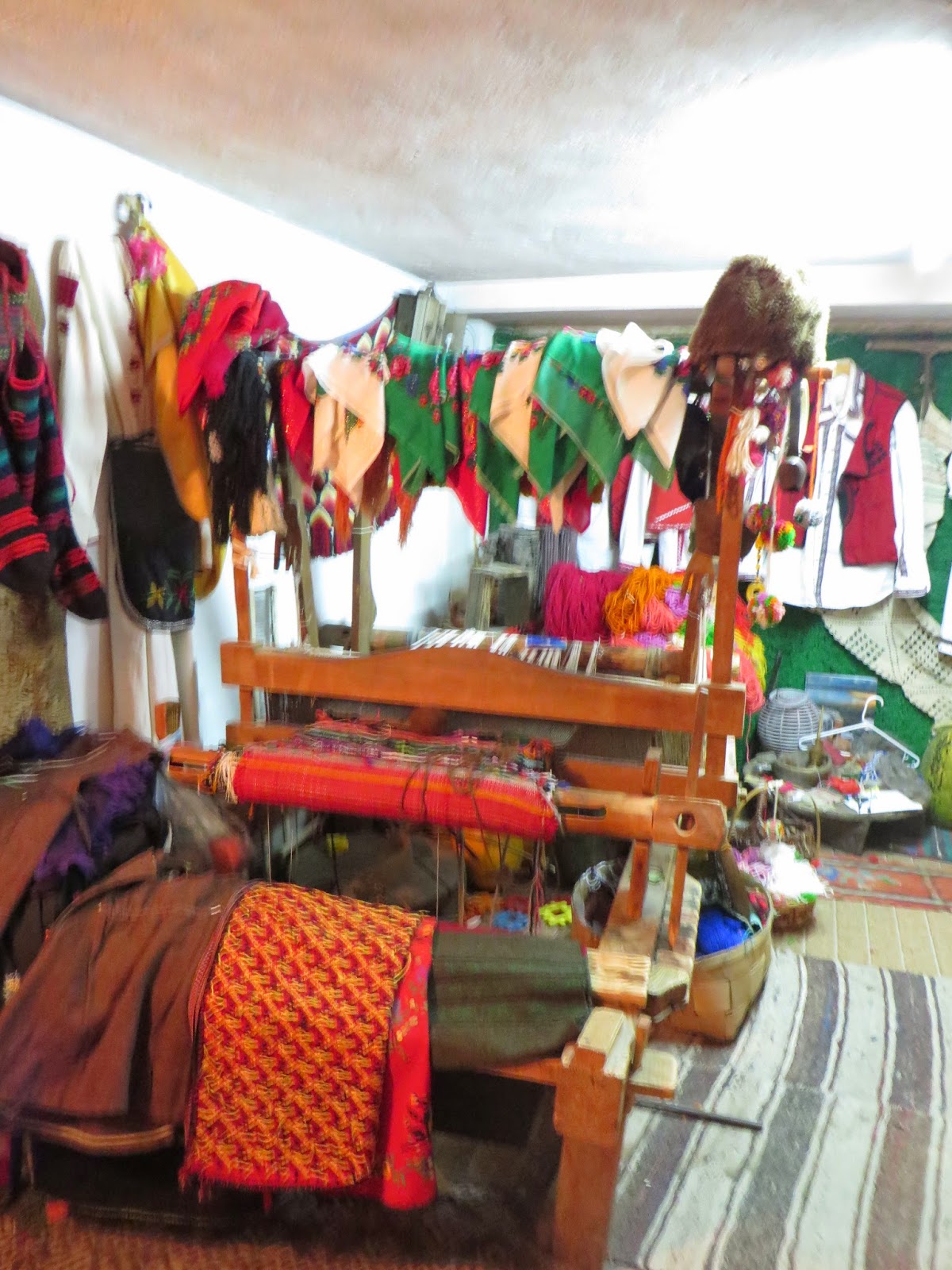
After days of experiencing big city life, it was wonderful to arrive in the village of Gorno Draglishte.  We stayed in a local guest house and were immediately immersed in traditional life.  Best of all, downstairs off our dining area, was the family’s repository of local crafts.  A large loom took centre stage and various samples of textile work were hung around a wall.  Somehow I missed a local shop where others bought a few handcrafts.
Loom & costumes at the ready...

Need to wash your quilts?  Perfect, I have just the very thing!

By now we were noticing the weather was certainly getting colder (& wetter!).  This was handy because Bankso is one of Bulgaria’s premier skiing resorts…and the snow certainly arrived with us. 

Luckily we had spent an afternoon at the bear sanctuary (rescued bears) while the roads were still passable (and the bears still awake!).  However it was such fun to frolic in mounds of that fresh powdery snow! 

Our hosts were especially kind and provided plenty of sustenance (chocolate éclairs, red wine, rakia) and a lovely blazing fire.  We were thoroughly spoilt!
Not especially fond of humans I imagine after some very rough treatment

We trained through snow covered forests to the delightful city of Plovdiv.  It was slightly warmer but still wet!  After a walking tour through the old town we were able to explore on our own.  I headed for galleries and museums to continue my textile discoveries.  Our tour was nearly over!  Thankfully, I managed to find a few antique shops and at one, discovered a locally made weaving.  

Ethnographic Museum Plovdiv


Links to Bulgarian textile information as follows:


(The tour we took was Intrepid’s Eastern Europe Explorer.  It was a general tour, not textile specific, but I certainly had the time and expertise of our various hosts to point me in that direction.  I will also confess to having done a little research prior to taking this trip so that it was not a wasted opportunity.  You will see from the links that Eastern Europe has a long history of folk art and textiles - at all levels of society.  It was wonderful to experience it and we highly recommend the tour, although the travelling style may not suit everyone.)

Monday, 26 January 2015

Textile Hunters: Romania

Romania
14th October 2014


Our room in Maramures was decorated with Ramona's handiwork
If Eger was “small town”, then Maramures was positively rural.  And the textile trail was hotting up!  Our homestay host, Romana, had her house beautifully decorated in the traditional way with all manner of textiles.  We also had a day tour of the local area organised, fitting in visits to the Painted Cemetery, the Holocaust Museum, an ancient wooden church, a working farm that used water driven tools and a painted monastery.  The link to textiles became quite clear – making cloth and decorating textiles was once just part of life. 
The Black Wooden Church

Textiles inside the Black Church

Felt made with an antiquarian water-driven pounding machine

The Painted Cemetery
In the old town of Sighisoara, we first met up with Vlad the Impaler (aka Dracula).  Perched high on a hill (a good defensive position), this walled complex certainly retains something of the character of those dark old days.  Gloomy covered stairs reek of headless horsemen, whilst a maze of narrow, cobbled streets offer secret places to hide or be hidden.  Overhead, massive towers loom dramatically and a cemetery has just the right amount of unkempt greenery.    
Sighisoara's Town Square - site of some nasty goings-on in the old days!

We took rural to a new level in Viscri, where our host had restored a number of houses in this peaceful village. 

It was like a living museum and we very much appreciated friendly locals who treated us to living the good life.  The fortified church had a few rooms of costumes & textile folk crafts to browse through, so with a pair of locally made felt slippers, we were making connections at last.


Brasov became our base for a day tour of exquisite Peles Palace, medieval Rasnov Fortress and Dracula’s most famous, Bran Castle. 

We had a great day sticking our nose in to see how the rich and powerful lived during the various eras covered by each castle.  Brasov itself has a rich and most interesting history and we wandered for a few hours inside and out, of the old city walls. 

The time had come however to seek out an ethnographic museum and Brasov’s fit the bill especially well.

Looking soldierly in Brasov

Bran Castle...Vlad stayed here once

Beautiful costume in Bram Castle

We drove through beautiful autumn forests catching glimpses of snow as we made our way by bus and train to eventually arrive in Bucharest.  This is a stately and reserved city with vast monoliths built to commemorate the might of conservative communist leaders.  We explored the city, delighted by its many paradoxes and yet again managed to unearth a link to Vlad the Impaler, with foundations of his Princely Court in the city centre.  I found a few vague textile connections though didn’t have time to fully explore museums.  The weather was nice, the park attractive with row boats, black swans and old men playing board games.  So instead of pounding the pavement, we sat lake-side and took in the ambience over a local beer or two.

Again, a few more interesting links to explore Romanian textiles:

Romanian Ethnic Art (Pinterest)
Shop display looking rather enticing but closed! 

Monday, 19 January 2015

Textile Hunters: Hungary

Hungary
11th October 2014


We shot through Hungary like cannon balls on a mission, stopping only briefly in Budapest where our tour was to start.  The city is not unlike Vienna, only darker and deeper, which makes it rather intriguing and certainly worth exploring.  Had we planned a longer stay (more than 2 days!) we could have covered a lot more ground and arranged a tour list from many “unusual” options including spa treatments or seats at the Opera.  Or done a myriad other equally interesting things...


Eger was our other landmark stop in Hungary.  It proved to be a fascinating small-town mix of ancient and modern cityscapes.  Here we touched base, albeit briefly, with a little local culture, down deep in a wine cave.  Our host, as effervescent as her wines, arranged for local musicians to serenade us.  We felt we were in a time capsule.

Having imbibed more than we should the night before, our short stay in Debrecen became one of “resting” in the town square under shady trees, going for short walks and finding a very modern shopping centre.  The local flower market was a mass of brilliant colour and sidewalk cafes positively buzzed.

Debrecen Station
There was so much to see and experience that textile hunting, unless obvious or nearby, did not feature in our discoveries.  Needless to say, Hungary has a long history of folk arts and so I’ve unearthed a few sites that offer a little overview of the arts we sadly missed.

Hungarian Folk Art (Pinterest)

Street Art

Sunday, 31 August 2014

Yarning on Poros

Poros
14th July 2014


Poros is one of those memorable Greek Islands.  Small in size, with a picturesque white village climbing a steep hill behind, it is a busy port town catering to a wide range of international and local tourists – without being too fussed about it.  It’s also well protected and for many, a pleasant escape from the summer’s strong Meltemi (winds). 

Walking the town one morning, we found this fine example of guerilla knitting, also known as yarn bombing.  Hardly in keeping with everything Greece, but a wonderful surprise.  There was a little information, mostly in Greek, but I was unable to track down if it was part of an exhibition or just an element of surprise in what is invariably a traditional village. 

(We have our own guerilla knitters on Dangar, hence my interest.  Perhaps we could sister-village knitting groups with them?)


Sunday, 27 April 2014

To Market To Market

Adding Kilos

I’m talking baggage limits here! 
We had been fortunate to have covered quite a few markets in our tour of Japan – by design or accident – and were disappointed not to have argued for a triple luggage limit on the flight home. (Can you do that?)  Markets in Kyoto are a textile shopper’s heaven. (My notes remind me that we felt an earth tremor whilst at To-ji Temple Market.  Perhaps it was a sign.....)

Our last morning was spent at the bustling To-ji Temple monthly market, Kobo-san.  Sadly, we only admired the Momoyama period buildings if our eyes strayed momentarily from stall after stall of fascinating goodies.  (Held on 21st)
 

Earlier in our tour we had visited the Chion-ji Market (1234) which has a reputation for food and handmade clothes.  I think we found piles of old kimonos for display.  How many can one person have?  (Held on 15th)
To-ji Market

   
We had also stumbled across the Myoren-ji  Market, a low key affair but non-the-less most interesting.  This market had the feel of a very local experience and whilst we didn’t buy much (well, perhaps some of us were more restrained than others!), it was worth stopping in.  We descended upon a local fabric store very near to this market.  I dare say it was an interesting experience for the owners too! (Held on 12th)
Miyagawa (Takayama) Morning Market is a daily affair held in the old town area along the river.  Stall holders sell flowers, vegetables, preserved foods like pickles and the odd rather lovely souvenir. 
Takayama Market

Having unearthed a few bargains at To-ji Temple, we made our way back to the hotel to repack our bags (redistribute the weight – how did we manage to fit so much into them?).  Then it was back to the Kansai International Airport to head for home.
This is my disclaimer!  Memory is a funny thing and whilst I have a clear picture of some days, others are fuzzy. In pre-digital times, I didn’t take nearly enough photos and of course now regret not having kept a decent journal – simply because you do forget!  I hope therefore to have included everything but am open to “corrections”.  It was a fantastic journey and a great experience.  What better introduction to world textiles could one have….
Kansai (with luggage!)

Not the best of photos but nice to see our new home from above

Saturday, 26 April 2014

Beautiful Museums

Costumes & Crafts

After walking Nara, we made our way back to Kyoto to visit the Museums and sites we had skipped earlier on in our tour (due to the evening viewing of the famous Kamogawa Odori, the annual dance festival performed by Pontocho maiko).  It does pay to be flexible!
Fuzoku Hakubutsu-kan, the Period Costume Museum, shows costumes from the different periods of Japan’s history; Samurai, fire fighters and Edo-era kimonos.   I fell for Ainu costumes, having initially seen one at our workshop with Master Indigo Dyer, Mr Kenichi Utsuki.

Ainu Costume
We were also treated to a demonstration of yuzen silk painting. Kimono lengths and obis were being hand painted in an intricate, multicolour process.   I must admit that I’ve quite forgotten where we saw this painting and stencil dyeing demonstration but am hazarding a guess that it was the Yuzen-en Gallery.  Whilst there we saw the most magnificent kimono of gingko leaves in yellows on a background of grey and white mountain mist.  What a shame I didn’t get a photo of it!  Kyo-yuzen silk dyeing (actually stencilling) is special to Kyoto.
After the museums we headed back to the Shinmonzen-dori Antique shopping district in the Gion area for one last look and to purchase yet more fabrics.  These were rather special as these were antiques!   

Having arrived at our hotel rather late (& a wee bit weary) that evening, we stopped long enough for a noodle dinner at a small shop in the Kyoto railway station complex.  Unbelievably, it was our last night and we wanted to celebrate this wonderful tour and thank our excellent host, Margaret.

Tucking in to cook-your-own noodles

That night we went to sleep to the sound of Bosozoku, motorcycle gangs, who noisily rev their bikes and speed off in races through the streets.

Thursday, 24 April 2014

Ginko Leaves in Nara

Train to Nara

Beautiful Gardens in Nara

Next stop for us was Nara, birthplace of Japanese culture and first capital (710-784). In fact there are so many fascinating and ancient sites, the area is UNESCO Heritage listed.  Interestingly for us, this city was the eastern-most stop of the famed Silk Road, the ancient trading route between Asia and Europe. (We have since been following another section of this famous route on our Turkey travels in Bursa last year.)

Making good use of the train station across the road from our hotel, we took a local train (a 45 minute ride) to start our walking tour of this very famous city.  We did our best and covered (in no particular order):


Temple Ticket

Amazing building - always busy

Todai-ji Temple houses the Great Buddha, a huge bronze statue, in an even larger wooden building.  This charming, yet mysterious Great Buddha stands 16m (50') high and dates from the Edo period.  There were earlier versions of Cosmic Buddha, sadly destroyed over the centuries by fire and earthquake. This current one, all 437 tonnes of him, is still quite magnificent.

The building the Buddha is housed in dates from 746 and its dark, solid time framework adds to the overall mood.  The columns are so huge, that one with a hole at the base attracted a line of giggling school children waiting in turn to squeeze through it.  It is believed that those that can make it are ensured enlightenment. 

Perhaps that’s a good thing when your only 10!

Deer have Right of Way & Insatiable Appetites

Surprise! We know where you store those goodies!
On our way out, we passed the fierce temple guardians, bronze statues cast by the famous master, Unkei (1150-1223) and headed through the famous Isui-en Garden (Meji Era) and on to the Deer Park.  As we strolled we were met by lots of tame Sika deer, said to be messengers of Shinto gods. 

The deer were certainly not afraid to demand food. Warning - keep your bag closed!  We walked our legs off yet managed to only cover a small area of this attractive 1250 acre parklands. 

Deep in the park is the Kasuga Shrine.  It is considered the most beautiful Shinto shrine in Nara, and features some 3000 antique stone and bronze lanterns; a real feast for our eyes.

On our way back to the station through streets lined with fluttery leafed Ginko trees, we paused to look at a local pottery shop and then admire the beautiful Kofuku-ji Temple (710) with its distinctive three and five storey pagodas or tiered towers.

A typical Japanese pagoda has a square plan, rises 3 or 5 storeys and supports a spire of Rings of Heaven.  The ground floor is usually used for shrines and images, whilst upper floors provided observation platforms.  Each level is suspended around a central pole which allowed it to resist earth tremors.

Another busy day - another train ride back to Kyoto....