Friday, 1 December 2017

Remembering The Blue Pearl

Beautiful Sky Blue to remind me of Chefchaouen

Whilst on the subject of handloomed weaving, I wasn’t sure if I’d posted photos of the beautiful, traditional woollen blankets we found in Chefchaouen, Morocco (suitably measuring up to it's nickname, The Blue Pearl).  


Weavers, generally men, sit in bolt-hole shops along the narrow, picturesque streets of Chefchaouen producing blankets, cushions and rugs in the most wonderful colours.  Now, I do use the term ‘woollen’ lightly as I expect there is a scarcity of the real thing in my blanket given how inexpensive acrylic yarns are nowadays.  However, I am only guessing and have no evidence to support such a negative remark.  Further, the pillows I purchased the following year when visiting with friends are standing up well to quite some punishment on our equally well-used settee.  No sign of pilling, on the cushions or the blanket, so I may well have to eat my words. 

And I couldn't leave the cushions behind, right?

A summary of our finds on this tour through Morocco & subsequent stops in Chefchaouen are covered in earlier Textile Tourist posts which can be easily found via the Morocco 2012 link over in the sidebar.  Even more detail can be found on the Windjammer3 site (link here).  I would most happily fill my house with goodies that can be found in any of the souks we visited…but maybe, mostly the Aladdin’s cave that is Fez! 

I've just been re-reading a wonderful travel book by Eric Newby (a Brit), "On the Shores of the Mediterranean", a journey he took in the 1980's with his wife, Wanda.  The whole book is fascinating to read again, now that we've managed to visit some of the many places he's written about.  Without doubt, he captures the essence of Fez; Moroccan to the core and so culturally rich.  Visit if you can, you'll be all the better for doing so...if not a little poorer!!  
I found this photo of an embroidered Horse Cover
from Fez.  Its in Wiki along with other location facts.

By the by, even though it's Autumn here in the Med, it really is Spring (well, only just) at home.  Hence my need to tidy up & refresh the blog a little with a rather sweet, new look.  Even more links to follow when I find them again...

Monday, 27 November 2017

Get Back to Work!

November 2017

Cushion made from a small Portuguese hand-loomed rug
At this stage, it’s been so long since I’ve had the time or energy to put up a post on our wanderings that I’m just going to start with the here and now; and then slowly work back with interesting snippets when I can.  Consider this the equivalent of a cleansing ale at the end of a long and somewhat arduous year or two.

Currently we are in the Algarve; Lagos to be exact.  Our explorations to find supermarkets in Portimao brought us on a collision course with a couple of Chinese shops – positively stuffed to the brim with all sorts of things, especially those you never knew you needed.  I was searching for a yoga mat (impossible to find) to cut up and stuff into my ageing settee cushions for a bit of added ‘oomph’.  What I did find though, was floor mats, hand-loomed (in Portugal, even).  And I’ve found more in Lagos - I'm just so excited!
Blue & White hand-loomed rug
It seems that these mats, made from recycled textiles and woven on looms in villages across the country, are very much part of a Portuguese weaving tradition.  Trying to find any information is difficult due to the fact that they are considered so very utilitarian, but I do seem to recall finding some in a museum in Faro (Museu Etnografico) a few years ago now.  I’ll have to dig out those photos but that’s not going to help me give these woven mats a local name.

Yellow light does not show my blue & white quilt off but you get the drift...
In the meantime, I’ve settled on a rather nice blue & white “shaggy” number to liven up the very dull mat we have now in our bedroom.  It also goes nicely with the small blue quilt I made for the bed this year (just showing off, of course).  Another, smaller red/white & blue mat suited the guest bedroom but I hit on the bright idea of making it into a comfy cushion.  So now I have the perfect opportunity to poke around the shops in old Lagos a little bit more…
And whilst I'm shopping I can admire some
fantastic street art. Did I really find a Banksy?

Wednesday, 25 May 2016

A Brush with Fame


I was fortunate to see a travelling exhibition of Spanish Surrealist, Salvador Dali’s works in Dubrovnik.  It was quite refreshing to be allowed to take photos; thankfully someone’s realized the marketing potential of blogs and social media!

Speaking of marketing, Dali’s eccentric behaviour was another golden arrow in his quiver of talents.  In brief, Salvador Dali’s (1904-1989) life story makes for interesting reading.  He was a consummate showman and a great technical artist with a vivid imagination.  One famous quote that resonates for me when viewing his work is simply put: “Intelligence without ambition is a bird without wings.” 


Dali’s best known work is perhaps, “Persistence of Memory”, those melting clocks that at once captivate then frighten.  We though, were lucky enough to see the fabulous Mae West lips, translating sexy into functional and, at the exhibition, a range of his captivating prints.  Some were for sale!  My quick talking however failed to make an impression on my “man with the wallet”.  I obviously need to learn more from Dali.

You might enjoy this fabulous site WikiArt.

Captivated by the Dali Exhibition

Friday, 22 April 2016

Combing Croatia

July 2015

Croatia was also a too-brief interlude, and although we made stops in a number of places, the most textile-likely were Pula and Dubrovnik.   If you can take your eyes of stunning historic buildings, beautiful blue water and "I want to live here" island communities, that is!!

In Dubrovnik we had four lucky finds:
  • the Rupe Ethnographic Museum. The museum was challenging to find but it did take us into the less touristy areas of old Dubrovnik.  Who would have thought the old town to be so steep in places!
  • well stocked craft stores (especially the Korkula Art & Craft Store brimming with locally made products including some lovely embroideries),
  • more than one craftswoman stitching in the street (in costume & selling her hand-made wares), and
  • an open air market near the Cathedral (in the shade of its west wall) featuring textiles, crafts and jewellery. 

I later discovered that Croatia also has a significant lace-making community (bobbin lace from Lepoglavia; aloe lace from Hvar; needle lace from Pag) and a once highly productive silk manufacturing area in Konvale dating back to the 15th c.  Production of rick rack braid is also mentioned but I never managed to find any.

A couple of interesting sites to check out for more detail (than I managed to cover in this post) are textile blogs and reliable pinterest communities for information and eye candy. I am also drawn to a fabulous book on historic costume - with a very hefty price-tag...  (These links have since broken or are out of date!)

Still, Mothers Day is coming up.  I wonder if I could swing it?


Monday, 18 April 2016

Glory Days


Moving on from Santorini, our next stop was Crete - the main object of course, being Knossos.  A limited schedule dictated firstly a visit to the wonderful & enlightening Archaeological Museum in Heraklion; and I’m very pleased we did.  The museum exhibits are the “icing” on the cake of Knossos and thus prepared, we were better able to envisage the city as it might have once been in the Minoan (2600-1450 BCE) glory days, when we finally made it to this historic and most magic of sites.

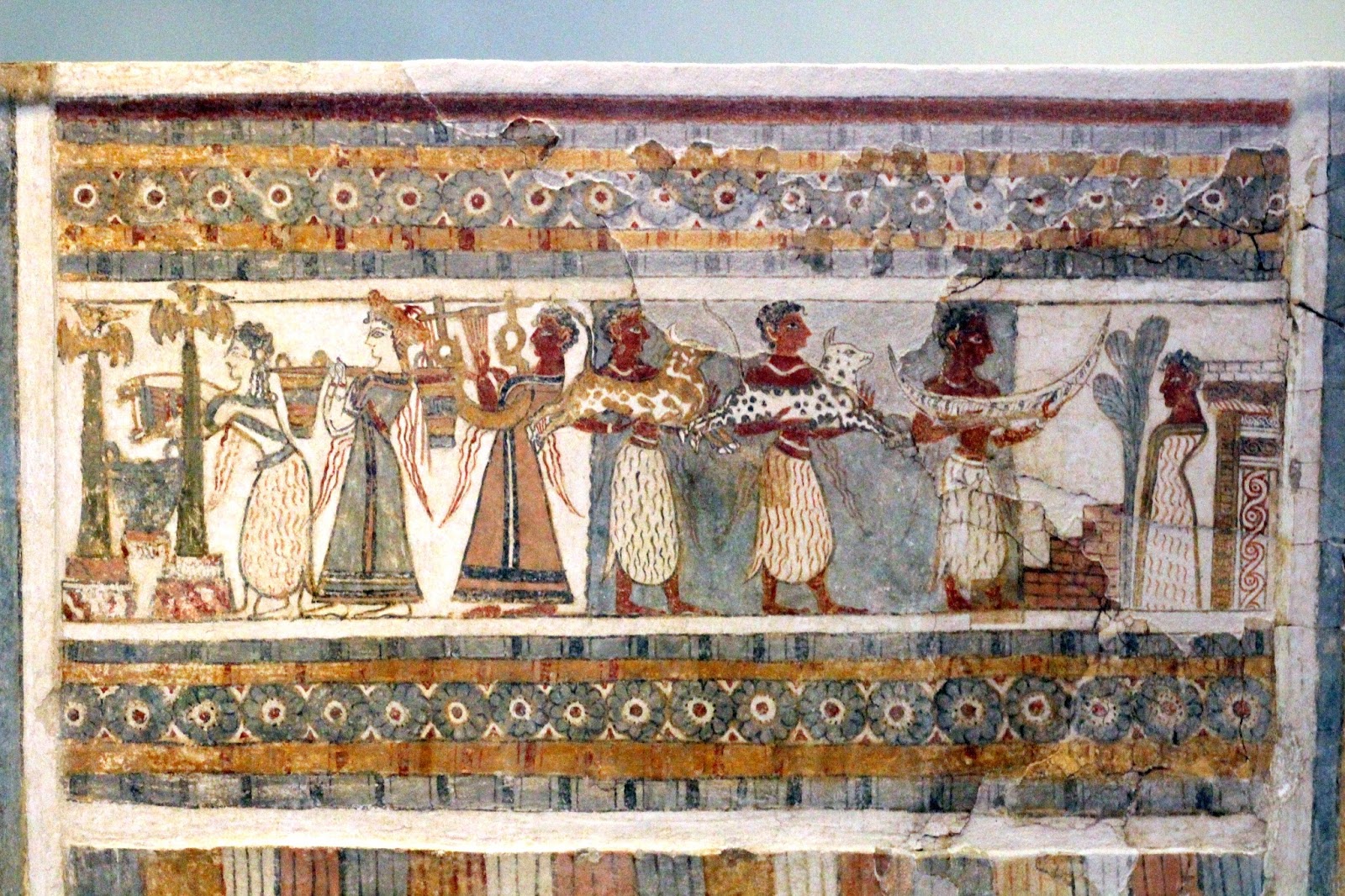
Delightful wall paintings and sensitive artwork on pottery, statues, religious and funerary objects gives insight into the Minoan love of elaborate textiles.  Men and women wear carefully fitted garments, some for rather athletic pursuits (bull leaping) and clearly prefer bright colours.  We understand that craftsmen and women were highly skilled in the art of spinning, weaving, dyeing and sewing/millinery, which was not accomplished in isolation.  The Minoans also had a reputation for being experienced sailors and traders – quite obviously with an eye for acquiring tasteful style; in design as well as expertise. 


We managed to visit a couple of other towns, mostly awash with tourist tat (made cheaply in China), with little success in uncovering locally produced modern textiles.  Time sadly was against us to be more thorough.  I did read later (on the ferry out, no less) of the inspiring Penelope Ghandi Mission on Crete.  It has been established to revive the fine art of weaving.  Local craftswomen make traditional and unique Cretan weavings & embroideries.  I’ll just have to go back then…some day!


(Whilst searching for some informative links on the topic of Minoan textiles, I came across these: an interesting blog (textileranger) and a short article (unl) that helps in understanding Minoan life & times.  By now, you’ve probably realised that curiosity forms my cornerstone rather than a solid learning base.  Anyhow, I doubt that I’d live long enough to study textiles in sufficient depth to parallel the extent of our excursions, so skimpy my notes will remain…  )

Tuesday, 12 April 2016

Ever so Briefly, Santorini

Santorini, Greece: 7 May 2015 

To begin at the beginning of the season, we made a short detour via ferry to Santorini, allowing ourselves only a few days to enjoy the delights of this scenic island.
View over the Caldera (looking south towards Oia)

Textiles don't survive time well, especially not after catastrophic eruptions.  So at best in Fira's museums, we discovered a few more robust examples of how Thira locals (mostly the wealthy ones who could leave something for posterity) lived out their daily lives.   

We know the Ancient Greeks wove extraordinarily well; legend has it that Penelope, wife of Odysseus, wove a shroud of fine linen for her father-in-law, Laertes.  And we know that they had used linen for quality clothing since 2800BC. 

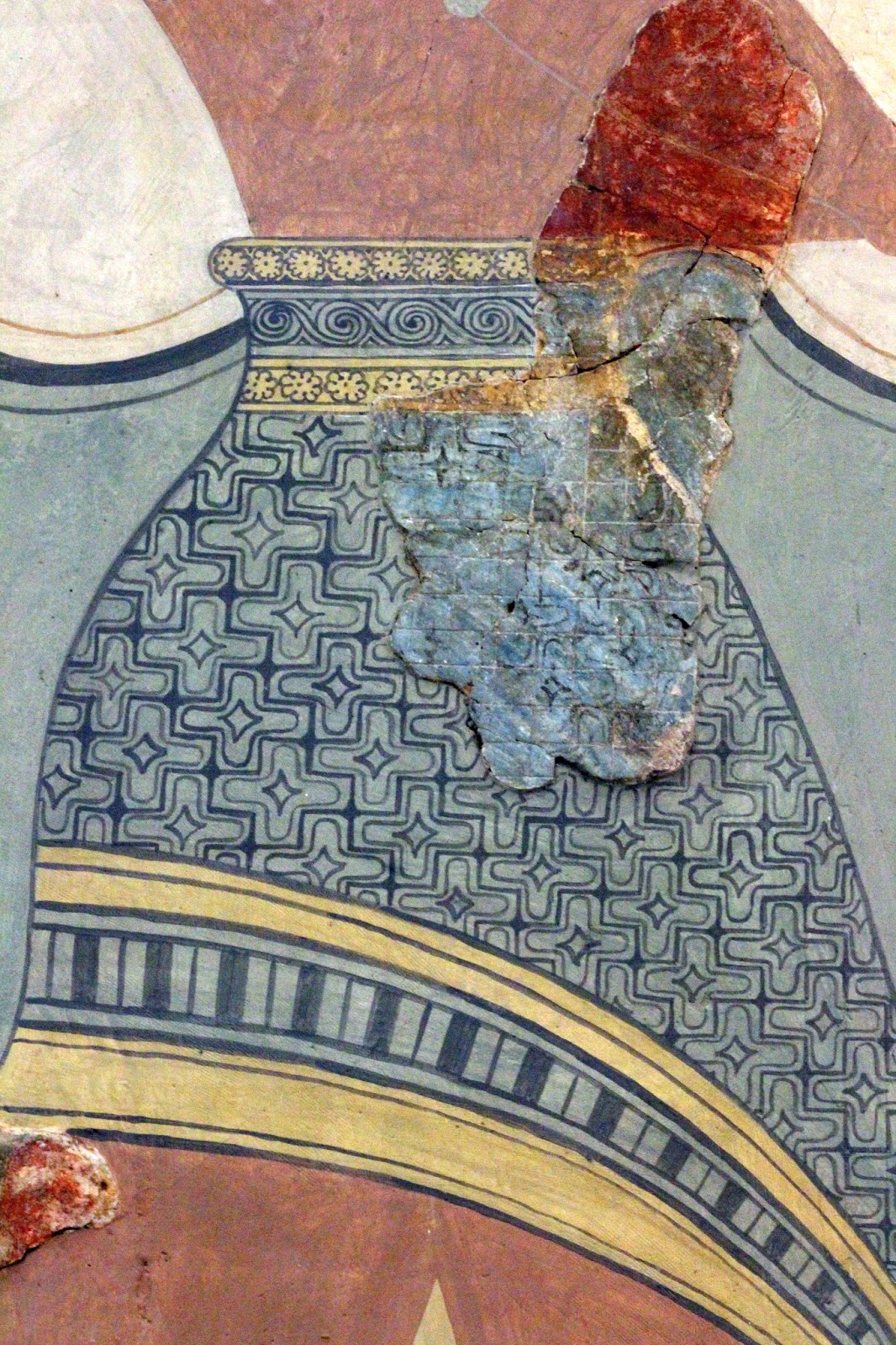
Luckily we have some extraordinary examples of pottery and murals that allow us to reflect on these skills. (Although I seem to have gotten carried away with marine rather than textile references!) 


This deserves a closer look to see that amazing detail. 
I'm wondering too, if this was our hero, Hercules...

Thursday, 7 April 2016

Voyages of Discovery

Exploring New Territory: 2015

Discovering new talents too!

This was a year of discoveries in more ways than “textile”.  We had a mini crisis with the Windjammer blog being “duplicated” and links redirecting folk to all sorts of nasty places (It’s fixed now by the way and both our computers professionally double checked for nasty viruses – all clean & clear!) and a mental breakdown when the camera memory card corrupted. 

Thankfully I managed to recover all but 10 of my precious photos - from a couple of thousand – about 8 weeks of travel to places we would probably never return.  (I’ll qualify that by saying - not because we don’t wish to, it’s just that living on the other side of the world makes it challenging in many ways to visit Europe regularly.)  The whole exhausting recovery process took months; figuring how to manage it and finally cataloguing files when retrieved.  Needless to say, I’ve been avoiding touching any photo files lately in case they vanish in a puff of smoke! 

So here I find myself in April already with NO entries in Textile Tourist yet.  So rather than take more time to include detailed research of textile offerings from each of the countries we visited, I’ll simply post up a few of the photos of interesting items we found along the way.  Somehow, I’d also neglected my homework in preparation for this tour and managed to miss quite a few textile museums, galleries or shops of interest.  I did find a link to the European Textile Network but the dots between our tour & those places did not always meet up.  Always wise in hindsight!

Sometimes the locals simply would not
share their textile secrets
Just so we are on the same table, I see Textile Arts encompassing patchwork & quilting, weaving, dyeing, tapestry, needlepoint, embroidery, textile design, spinning, knitted fibres, folk costumes and traditional motifs.  I know I’ve missed a few categories but it’s a start.  This list gives me a reference point to search for specific samples on my travels.  In some places we visit for instance, the best I might do is visit an ethnology museum.  A couple of excellent text references (to start with) are John Gillow’s “World Textiles” (an exhaustive techniques list) and “500 Years of Textiles” by Jennifer Harris. 

Even surfing the net yields surprising results - the Book Depository lists fascinating reference materials at a wide range of prices and Pinterest offers amazing catalogues of textiles visually.  I also find it interesting to talk to docents (trained guides) about their country specific textile collections at museums.


But I’ll leave the finer detail & last word to the experts.